
(See About Us for links to photos of past post activities)
POST 1921 OFFICERS
| 2021 CO-Chuck Jamison XO-Dave Reynolds Comp-Sandy Welsh Adj-Kathleen Heeren |
2019 CO-Chuck Jamison XO-Dave Reynolds Comp-John Hassenplug Adj-Sandy Welsh |
2018 CO-Jerry Long XO-Dave Reynolds Comp-John Hassenplug Adj-Sandy Welsh |
| 2017 CO-Jerry Long XO-Dave Reynolds Comp-John Hassenplug Adj-Jo Lawrence |
2016 CO-Jerry Long XO-Dave Reynolds Comp-John Hassenplug Adj-Jo Lawrence |
2015 CO-Jerry Long XO-Jim Hamilton Comp-John Hassenplug Adj-Jo Lawrence |
2014 CO-Bob Wyllie XO-Jim Hamilton Comp-John Hassenplug Adj-Mike Medeiros |
2013 CO- Tod Murdock XO-Jim Hamilton Comp-John Hassenplug Adj-Mike Medeiros |
2011-2012 CO- Tod Murdock XO-Iain Morrison Comp-John Hassenplug Adj-Mike Medeiros |
2010 CO-Bryan Harris XO-Tod Murdock Comp-John Hassenplug Adj-Mike Medeiros |
2009 CO-Bill Wallace XO-Tod Murdock Comp-John Hassenplug Adj-Jo Lawrence |
2008 CO-Bill Wallace XO-Rob Rydbeck Comp-John Hassenplug Adj-Jo Lawrence |
2006-2007 CO-Chuck Jamison XO-Rob Rydbeck Comp-John Hassenplug Adj-Jo Lawrence |
2005 CO-Chuck Jamison XO-Rob Rydbeck Comp-John Hassenplug Adj-Sherry Oppenheim |
2004 CO-Fran McVey XO-Chuck Jamison Comp-John Hassenplug Adj-Sherry Oppenheim |
2003 CO-Fran McVey XO-Chuck Jamison Comp-John Hassenplug Adj-Larry MacDuff |
2002 CO-Fran McVey XO-Chuck Jamison Comp-John Hassenplug Adj-Larry MacDuff |
2000-2001 CO-Jo Lawrence XO-Fran McVey Comp-John Hassenplug Adj-Larry MacDuff |
1999 CO-Jo Lawrence XO-Fran McVey Comp-John Hassenplug Adj-Dick Combe |
1998 CO-Jo Lawrence XO-Fran McVey Comp-John Hassenplug Adj-Dick Combe |
1997 CO-Jo Lawrence XO-Steve Emling Comp-Dave Schleeter Adj-Dick Combie |
1993 CO-John Hassenplug XO-Steve Emling |
1991-1992 CO-Pat Patterson Comp-Robert J. Nelson Adj-Dick McKee |
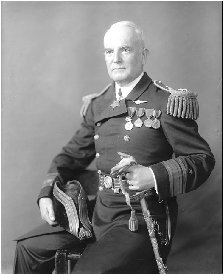
Admiral William A. Moffett
Rank and Organization:В В В Commander, U.S. Navy.В Entered service at Charleston, South Carolina.В Born October 31, 1869, Charleston, South Carolina.В G.O. No. 177, December 1915.В Awarded Distinguished Service Medal.
Citation:В В В В В В В For distinguished conduct in battle, engagements of Vera Cruz, April 21-22, 1914.В Commander Moffett brought his ship into the inner harbor during the nights of the 21st and 22nd without the assistance of a pilot or navigational lights, and was in a position on the morning of the 22nd to use his guns at a critical time with telling effect.В His skill in mooring his ship at night was especially noticeable.В He placed her nearest to the enemy and did most of the firing and received most of the hits.
William Adger Moffett was born October 31, 1869 in Charleston, South Carolina and he graduated from the United States Naval Academy in 1890. He served on various vessels, including the USS Charleston in Commodore George Dewey’s fleet at the Battle of Manila Bay during the Spanish-American War and by 1905 had risen to the rank of Lieutenant Commander.
He was promoted to Commander in 1911 and took command of the USS Chester in late 1913. He was aboard it, in Admiral Henry T. Mayo’s Division, when the Tampico Incident occurred on April 9, 1914, and he took part in the occupation of Vera Cruz, Mexico, that followed on April 21-22, winning the Medal of Honor for a daring and unguided night entry into the inner harbor to land a force of Marines and Seamen.
In 1914-1918, he commanded Great Lakes Navel Training Center and the 9th, 10th and 11th Naval Districts, receiving promotion to Captain in August 1916.В During 1918-1921 he commanded the USS Mississippi and in March 1921 was appointed Director of Naval Aviation with the temporary rank of Rear Admiral, which was made permanent in 1923.
Too old for flight training, he had qualified in June 1921 as an aerial observer and the creation of the Navy’s Aviation Bureau owes much to his influence. He organized the Navy’s aviation program, exerted influence for the expansion and experimentation, oversaw the selection of sites and building of Navel air stations and accomplished the installation of aircraft landing catapults on all battleships and cruisers of the Fleet.
He was particularly enthusiastic about the use of dirigibles; both in Naval operations and more generally, secured for the Navy the airships Los Angeles, Akron and Macon.В He was reappointed to head the Bureau in 1925 and again in 1929.
Admiral William A. Moffett died on April 4, 1933 in the crash of the Akron in a storm off the New Jersey coast.В He was subsequently buried in Section 3 of Arlington National Cemetery.В
Note: Admiral Moffett’s son, William Adger Moffett, Jr., Rear Admiral, United States Navy, died on July 23, 2001 and is also buried in Arlington National Cemetery.
Crash of the Akron
On April 3, 1933 the Akron, under command of Commander Frank McCord was off the coast of New Jersey, fighting its way through a thunderstorm.В Because of the winds, heavy cloud cover and ground fog the navigator was unable to determine their drift rate and could therefore not approximate how far off their course they really were.
The weather reports from the wireless radio told of low pressure over Washington D.C. and this was mistakenly assumed to be the center of the storm.В In reality, the storm that the ill-fated ship was flying through was actually an entire storm front and one of the worst that the New Jersey coast had seen in years.
The Captain decided to turn back to shore but upon arrival of the coast no break in the storm could be seen. The order was given to head back out to sea and simply ride out the weather. After several hours the Akron found some calm air. Even through the storm could be seen flashing all around; it looked as though everything was going to turn out all right. This was no doubt a relief to the ship’s Captain.
On board were two very important men, Rear Admiral William Moffett, Chief of the Navy Bureau of Aeronautics, and Commander Frederick Berry, Commander of the Lakehurst Naval Air Station, and he was hoping to impress them with his ability to command an airship.
At a quarter past midnight, a horrific blow rocked the Akron.В The calm that the unfortunate air ship had felt was in fact the eye of the storm system.В As it emerged from the other side of the eye, fierce winds caused the massive airship to buck wildly.В Suddenly the ship hit an enormous downdraft and was sucked down almost a thousand feet.В Only by dropping most of the water ballast and full power to the engines could the decent be stopped.В The Akron was able to gain altitude briefly but was pushed down again and again until finally the force of the storm started to rip the ship apart.
With loss of control of the fins, the Akron smashed into the freezing water of the Atlantic. Because the Akron carried no life vests and there hadn’t been enough time to lower the one life raft, seventy-two of her seventy-six man crew drowned, including Rear Admiral Moffett and Commander Berry.
The tragic end of the Akron shocked the world and the U.S. NAVY.В In this one crash, the airship had lost much of its support in the military and civilian world.В
Two videos produced by SAMS member Mike Shaw are similar but with different photos and music:
Scottish American Military Society 2010
Scottish American Military Society 2011